Why Relationship Advice Sounds Better Than It Often Works
Why Relationship Advice Is Everywhere
Relationship advice is everywhere.
Open social media and you’ll find people explaining what healthy relationships look like, what unhealthy relationships look like, what behaviours should be tolerated, what behaviours shouldn’t, when to stay, when to leave and how to spot a red flag before you’ve even finished your morning coffee.
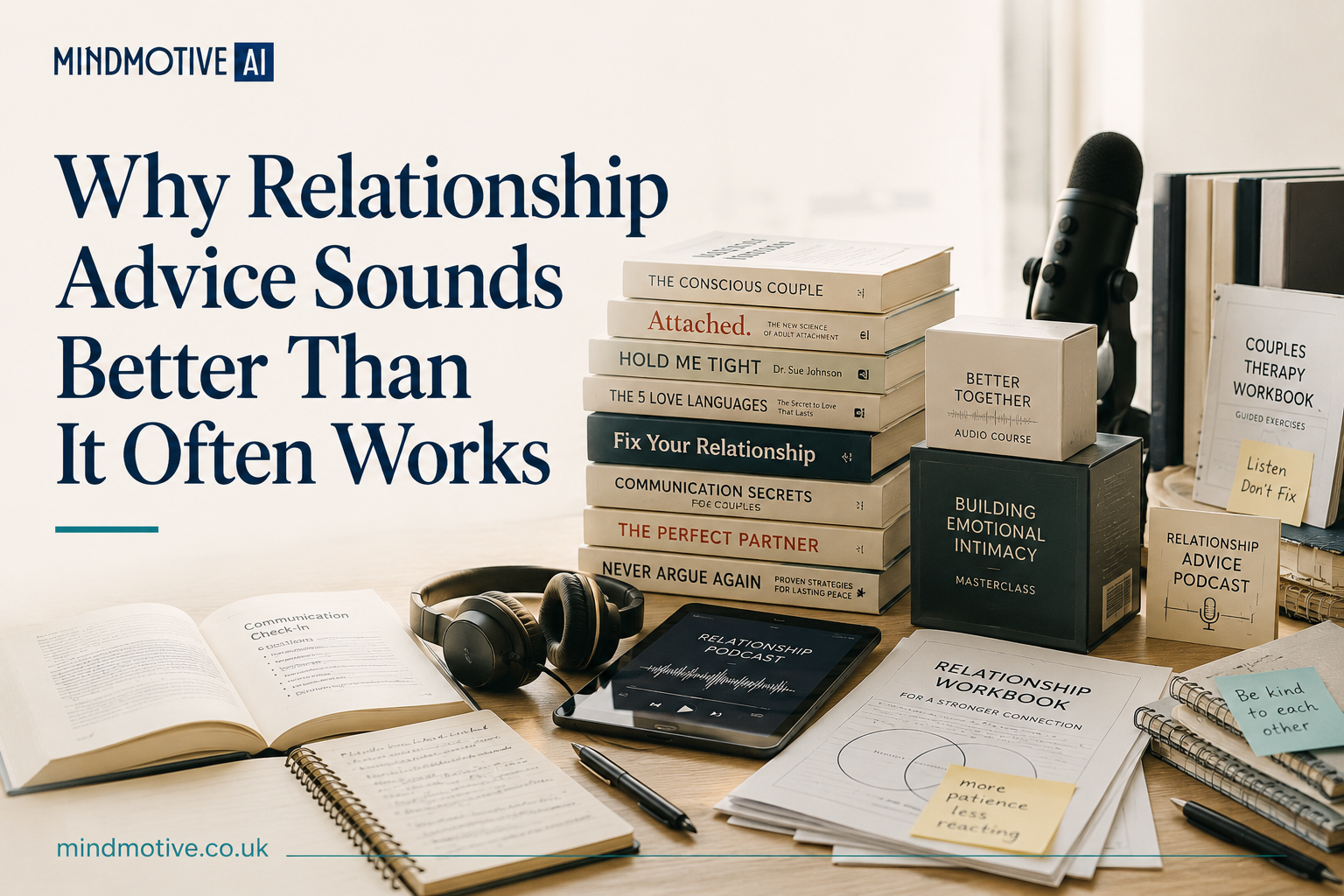
There are books, podcasts, courses, influencers, therapists, coaches, articles, videos and endless opinions from people who are absolutely certain they know what you should do next.
Many of these messages are popular for a reason.
They are simple.
They are clear.
They are confident.
Most importantly, they offer something many people are desperately looking for when relationships become difficult: certainty.
Most people do not start searching for relationship advice because they are curious. They start searching because something feels uncertain, uncomfortable or unresolved. Perhaps they are questioning a partner’s behaviour. Perhaps they are wondering whether their own reactions are reasonable. Perhaps they are trying to decide what to do next.
They want answers to questions such as:
- Am I overreacting?
- Are they being unreasonable?
- Should I say something?
- Should I leave?
- Am I expecting too much?
- Am I accepting too little?
The more emotional the situation becomes, the more attractive certainty often feels. That is why phrases such as “If they wanted to, they would” spread so easily. They remove complexity and provide what appears to be a straightforward answer to a complicated question.
Unfortunately, straightforward answers and useful answers are not always the same thing.
The Appeal of Certainty
When people are hurting, confused or worried, certainty can feel reassuring.
A clear answer often feels better than an uncertain one. A confident opinion often feels more helpful than someone saying, “it depends”. This is one of the reasons relationship advice performs so well online. Certainty is easier to consume, easier to share and easier to remember than nuance.
The problem is that relationships are rarely simple, clear or certain.
Two people can appear to be facing exactly the same issue whilst dealing with completely different circumstances. One person may be struggling with communication because neither partner knows how to express themselves effectively. Another may be struggling because one partner has spent years ignoring every attempt at communication. The advice may sound identical in both situations, but the reality is very different.
Many of the most popular pieces of relationship advice become popular precisely because they simplify complexity. They reduce a messy situation to a short phrase, a memorable quote or a clear conclusion. That makes them appealing, but it does not automatically make them useful.
The Problem With Advice Created for Everyone
The biggest problem with generic relationship advice is not that it is always wrong.
The problem is that it is created for an audience, whilst relationships are experienced by individuals.
A social media post does not know you.
An article does not know you.
A podcast does not know you.
A relationship book does not know you.
An influencer certainly does not know you.
At best, these things can offer observations, ideas, perspectives and possibilities. What they cannot do is understand the reality of your specific situation.
They do not know:
- the history of your relationship
- what has already been tried
- which conversations have taken place
- which conversations have been avoided
- what matters most to you
- what you are willing to accept
- what you are unwilling to accept
- the practical realities of your life, your family, your finances, your values or your goals
Yet many people consume relationship advice as though it has been written specifically for them.
It hasn’t.
It couldn’t have been.
The person creating it has never met them.
Advice designed for everyone is, by definition, not designed for any particular individual. That does not mean it is useless, but it does place limits on how useful it can be when somebody is trying to navigate a real relationship rather than a hypothetical one.
Why Context Matters
Relationships do not exist in isolation.
Every relationship exists within a wider context made up of experiences, beliefs, expectations, patterns, habits, previous conversations, shared history and individual personalities. Remove that context and it becomes much harder to understand what is actually happening.
This is one of the reasons generic advice often struggles when applied to real situations. The same advice can produce completely different outcomes depending on the circumstances surrounding it.
One person may genuinely benefit from communicating more openly. Another may have spent years communicating and seen little or no change. One person may need stronger boundaries. Another may already have boundaries that are repeatedly ignored. One person may need patience. Another may have already been patient for far too long.
The advice itself may not have changed.
The situation has.
That is why context matters so much. Without context, relationship advice often becomes little more than an educated guess. It may point in a useful direction, but it cannot tell you whether that direction is right for you.
Relationship Quizzes and the Illusion of Personalisation
Even when relationship advice attempts to become more personalised, the results are often questionable.
Think about the number of relationship quizzes, assessments and questionnaires available online.
Answer a series of questions and you will be told whether your relationship is healthy, unhealthy, secure, avoidant, toxic, thriving or in trouble.
The problem is that these tools can only work with the information they are given. The questions may not accurately reflect your situation. The answers may not accurately reflect your experience. Important details may never be asked about at all.
The result is often a conclusion based on the closest available match rather than the reality of what is happening.
Human beings are messy.
Relationships are messy.
Most online assessments are not designed to handle that level of complexity.
They create the appearance of personalisation because the questions are directed at the individual, but the conclusions are still based on predefined categories. They are often working with a snapshot of reality rather than the full picture, yet people can easily mistake the result for something far more precise than it really is.
Why More Advice Often Creates More Confusion
This is one of the reasons people often find themselves consuming more and more relationship advice whilst feeling no closer to a decision.
When one answer does not help, they look for another. If that does not help, they look for another after that. Before long they may have read dozens of articles, listened to multiple podcasts, watched countless videos and consumed opinions from people with completely different backgrounds, experiences and beliefs.
At first this often feels productive. Gathering information feels like taking action. The problem is that more information does not automatically create more understanding. In fact, the opposite can happen.
One person says fight for the relationship.
Another says walk away.
One says be patient.
Another says stop wasting your time.
One says communicate more.
Another says you’ve already communicated enough.
The reason all of these positions can sound convincing is that they may all be correct in different situations. They are also often influenced by personal experiences, current social media trends, professional backgrounds and individual beliefs about relationships.
What worked for one person can quickly become what they recommend to everybody else.
Before long, people can find themselves collecting opinions rather than examining their own situation. They end up with more information than they started with, but little additional certainty about what they actually want to do.
The challenge was never simply finding more advice.
The challenge is understanding which, if any, of that advice genuinely applies to the relationship they are in.
The Difference Between Generic Advice and Situational Support
Generic relationship advice is created before the individual arrives.
The article already exists.
The book has already been written.
The video has already been recorded.
The social media post has already been published.
The advice was created without any knowledge of the person who would eventually consume it.
Situational support works differently.
A therapist, counsellor or coach can gradually learn about the individual, the relationship and the circumstances involved. The conversation becomes less about broad theories and more about what is actually happening.
History matters.
Patterns matter.
Context matters.
What happened six months ago often matters.
What happened six minutes ago may matter too.
Support becomes more relevant because it is no longer working with assumptions about a large audience. It is working with a specific person and a specific situation.
At the same time, traditional support comes with practical limitations. Appointments happen at specific times. Availability is limited. Conversations are usually restricted by session length. Support may not be available when something actually happens, and there is often a financial cost attached to every appointment.
These are not necessarily problems. They are simply characteristics of the model.
Why Otto is Different
Otto sits somewhere different.
Like other forms of situational support, Otto responds to the individual situation rather than relying on generic assumptions. He can explore the history, recurring patterns, conversations that have already happened and the wider context surrounding a relationship.
The difference is that Otto is there when the situation occurs rather than when an appointment becomes available.
A difficult conversation can be explored before it happens.
An argument can be discussed immediately afterwards.
Someone can spend five minutes talking something through, or three hours if they need to.
They can stop and return later.
Where Otto retains relevant context from recent conversations, they can pick up on things they have already discussed without always having to start again.
This changes the experience because support is available when it is needed rather than when it has been scheduled.
Instead of trying to remember everything for a future appointment, people can talk about situations whilst they are still unfolding. Instead of waiting until next week to discuss something important, they can begin now.
For many people, that creates a very different relationship with support.
Advice Versus Exploration
There is an important distinction between receiving advice and exploring a situation.
Advice can offer an opinion about what someone could do.
Exploration can help them understand the situation, challenge assumptions, consider different perspectives and decide what matters to them.
Both can be useful.
Friends have opinions. Family have opinions. Social media, books and podcasts offer plenty more. Sometimes another opinion is exactly what someone wants. At other times, the difficulty is working out what applies to their particular situation, what doesn’t, and what they want to do with it.
And sometimes people want both.
They want to hear what someone else thinks, but they also want to question it, explore the alternatives, add context and see whether that advice still makes sense once the whole situation is considered.
That is where advice becomes part of the conversation rather than the end of it.
Conclusion
Relationship advice often sounds better than it works because it is usually created for everyone whilst relationships are experienced by individuals.
The more personal, emotional and complex a situation becomes, the more context matters.
Generic advice can offer ideas, perspectives and possibilities. It can introduce concepts people may not have considered before. What it cannot do is fully understand the reality of a specific relationship.
That requires context.
It requires history.
It requires exploration.
And it requires support that can engage with the situation itself rather than simply offering answers designed for everyone.
The challenge is not usually finding more advice.
The challenge is making sense of your situation and deciding what you want to do next.
Relationships are personal. The support you use should be too.
Explore your situation, examine different perspectives and work through relationship challenges with Otto. Find out more here.
About the Author
Karen Ferguson is the founder of MindMotive AI, where she develops Digital Partners designed for specific purposes. Otto, built to help people make sense of situations, relationships and decisions at the point they need to, is one of them.
She has worked as a therapist for 26 years, as a hypnotherapist since 2000 and later as a counsellor, and for nearly 20 of those years as a trainer and supervisor. She has trained more than 1,000 therapists.
MindMotive AI was created in response to a simple question: what happens to the people who never access traditional forms of support? Karen’s work combines decades of professional experience with the deliberate development of Digital Partners designed to give people another way of accessing support when and how they choose.
Karen is a Fellow of the ACCPH (Accredited Counsellors, Coaches, Psychotherapists and Hypnotherapists).
Related reading
Otto: Why We Built a New Kind of Support. What Otto is, how it works and who it is for.