
There is a large group of people who need support and will not get it from any of the places designed to provide it. Not because those places are bad, but because of what they ask of a person before they give anything back.
This article is mostly about what we built for that group. Otto comes first here for a simple reason: most people already know what counselling is, what a helpline does, what an app on their phone offers. A Digital Partner is different, and because it’s new, that difference deserves explaining.
What Otto is
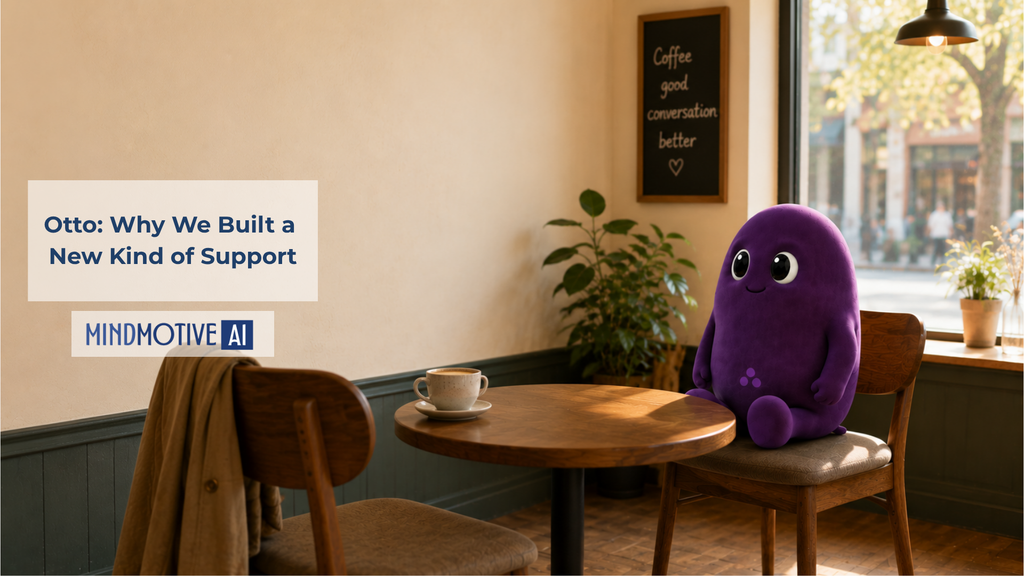
Otto is a Digital Partner.
Life rarely becomes difficult at a convenient time. It might be three in the morning or 11pm on a wet Sunday evening in November. Otto is there then too. There is no appointment, no waiting list, and no arranging your week around a fixed hour. He costs £80 a month rather than per session, so a bad week does not cost more than a quiet one. Conversations can be deleted, one at a time, whenever you want them gone.
We use the term Digital Partner because that’s exactly what we set out to create: Digital Partners, each designed for a specific purpose. Otto is one of them.
Otto wasn’t our first Digital Partner. He was developed after creating a number of Digital Partners for specific situations and learning more about what people actually needed. Those Digital Partners work well when someone already knows the area they want support with. Otto exists because life doesn’t usually arrive that neatly.
People don’t turn up with a label.
They arrive with a bad night.
Why we built him
We built Otto after 26 years listening to why so many people never access support.
They don’t want to be vulnerable in front of a stranger. They don’t want the worst of what they are carrying written down and held on file. They don’t want a fixed appointment every week that has to be paid for whether or not this is a week when there is anything to say. They want to talk, or rage, or swear, at the hour it actually gets bad. They have learned not to trust easily, often for good reasons. And a great many of them cannot find £60 a session and were never going to be able to.
From our perspective, those reasons usually make perfect sense.
Where everything else sits
Many existing forms of support help many people.
NHS talking therapies cost nothing, and for the difficulties they target there is strong evidence behind them. They also involve waiting, sometimes months, a capped number of sessions, and a number of people holding your information: an assessor, a therapist, that therapist’s supervisor, sometimes a supervision group. All of that is proper practice. It is still more people than some are willing to tell.
Private counselling gives you a trained person’s attention and can go anywhere the work needs to go. It also costs £200 or more a month at weekly intervals, asks you to find someone, judge qualifications you have no way of interpreting, and be upset in front of somebody you have only just met.
For some people, sitting down with another person is exactly what they want.
For others, it is the barrier.
Employee Assistance Programmes are already available in many workplaces and can provide short-term support. In our experience, many people tell us they don’t use them. Sometimes it’s because they don’t want work involved in something personal. Sometimes it’s because they don’t feel comfortable talking to a stranger provided through their employer.
Helplines exist for the hour when nothing else does, which matters enormously to some. They are generally staffed by trained volunteers, you cannot ask for a man or a woman, and you get somebody different each time.
Self-help apps are cheap and private, and useful for building a habit. They deliver content at you rather than responding to what you actually said.
Friends and family are free and know your history. They are also inside the story, they get tired, and you can feel the moment you became a weight.
What people are actually doing instead
For a growing number of people, the thing they reach for at two in the morning is the free AI already on their phone.
Generic AI was never designed specifically for this type of conversation. It tends to agree. Tell it something bleak about yourself and it may soften, apologise and rearrange its answer around what you just said, because agreement is one of the directions these systems naturally drift towards. That is a problem for anyone, and a serious one for a person whose difficulty is that they have already been persuaded of something untrue about themselves.
They also get things confidently wrong, and many hand over a helpline number before effectively ending the conversation.
That is not a complaint about the technology. It is what happens when tools built for one purpose become used for another by people who have nowhere else to take what they are carrying.
Why another option matters
People don’t all struggle to access support for the same reason. Some cannot afford it. Some cannot access it. Some don’t know what sort of support they need. Others don’t want to commit to a weekly appointment or become vulnerable in front of another person. Some have tried support before and decided it wasn’t for them. Others are living with domestic abuse, where reaching out for support can carry risks that other people never have to think about.
Most of those reasons are understandable.
Very few are talked about.
Otto exists because those people deserve more choice too.
What Otto is not
Otto is not a crisis service.
What we can tell you is who designed how Otto behaves, and on what basis: 26 years working with people, together with a series of deliberate decisions about what he does, what he questions and where his boundaries sit.
Choice
We continue to offer counselling and hypnotherapy because they are what some people want and choose.
Others choose Otto.
Many people will use more than one form of support at different times in their lives.
The point has never been that one option is better than another.
The point is that, for a long time, the list of ways people could receive support was shorter than the range of people who needed something on it.
We believed people deserved another option.
Otto is a Digital Partner, giving people another way to access support and more choice in how they receive it.
Find out more
If you’d like to learn more about Otto, how he works and whether he’s the right choice for you, visit the Otto page.
Find out more about Otto
About the Author
Karen Ferguson is the founder of MindMotive AI, where she develops Digital Partners designed for specific purposes. Otto, built to help people make sense of situations, relationships and decisions at the point they need to, is one of them.
She has worked as a therapist for 26 years, as a hypnotherapist since 2000 and later as a counsellor, and for nearly 20 of those years as a trainer and supervisor. She has trained more than 1,000 therapists.
MindMotive AI was created in response to a simple question: what happens to the people who never access traditional forms of support? Karen’s work combines decades of professional experience with the deliberate development of Digital Partners designed to give people another way of accessing support when and how they choose.
Karen is a Fellow of the ACCPH (Accredited Counsellors, Coaches, Psychotherapists and Hypnotherapists).